<?xml version="1.0" encoding="utf-8"?><feed xmlns="http://www.w3.org/2005/Atom" ><generator uri="https://jekyllrb.com/" version="3.10.0">Jekyll</generator><link href="https://www.sumofabatch.com/feed.xml" rel="self" type="application/atom+xml" /><link href="https://www.sumofabatch.com/" rel="alternate" type="text/html" /><updated>2025-06-12T20:59:23+00:00</updated><id>https://www.sumofabatch.com/feed.xml</id><title type="html">Sum of a Batch!</title><subtitle>Welcome to Sum of a Batch!&amp;nbsp; This site is about making mead, with particular emphasis on helping new people try making it, as simply and inexpensively as possible.&amp;nbsp; There are also calculators and other bits of advice, to help those who aren’t just starting out on their mead-making journey, but aren’t yet experts who know everything off the top of their heads, and can do all the math in their heads, either.</subtitle><entry><title type="html">Forgotten Milestone</title><link href="https://www.sumofabatch.com/blog/forgotten-milestone" rel="alternate" type="text/html" title="Forgotten Milestone" /><published>2024-01-09T00:00:00+00:00</published><updated>2024-01-09T00:00:00+00:00</updated><id>https://www.sumofabatch.com/blog/forgotten-milestone</id><content type="html" xml:base="https://www.sumofabatch.com/blog/forgotten-milestone"><![CDATA[<p>Whoops, looks like I’ve been forgetting to blog here
for quite some time! 
(I haven’t mentioned the very popular spiced cyser,
another batch of Lehua trad,
the tangerine honey, cranberries, and OJ concentrate batch
that I dubbed Tan-Cran-Ora but a friend suggest Orancrantan,
nor a few other not-terribly-unusual batches.) 
But that’s actually relevant to
a mead-making “milestone” I’ve “achieved”.</p>

<p>In early November, I started a batch of mead. 
(One five-pound jug of wildflower honey from Wegman’s,
a gallon and a quart of water,
and 71B yeast. 
The intent was to let it ferment dry,
and backsweeten with some of
the meadowfoam honey my wife bought me.) </p>

<p>Then I went on a few trips,
and then came the holidays. 
A few days into January,
I decided to try making cold-brew coffee. 
So I dug out the little bags. 
I had originally bought them
to hold spices for metheglyn,
so they were in one of my boxes of mead supplies,
next to where I stash my two three-gallon Fermonsters.</p>

<p>“Wait, that’s odd, I could swear I have two,
why is there only one there?!”</p>

<p>Yup, I had achieved the milestone of
completely forgetting about a batch I had started! 
Even sillier, I had been doing things with
another batch I had continued in the meantime! 
At least it was only about two months,
not years, like many cases I’ve heard of. 
It was in a cabinet under a kitchen counter,
where I almost never go unless I’m dealing with a batch of mead. 
(The other batch was elsewhere.)</p>

<p>The airlock had indeed run dry,
but it smelled normal. 
There were some suspicious-looking dark particles in the lees,
but I think that was just settled-out Bentonite,
since for primary I don’t generally make a slurry
but dump it right in. 
It’s now cold-crashing in the two-gallon bucket
that I should have used in the first place,
at SG 0.996 according to the Tilt.</p>]]></content><author><name></name></author><category term="daves-mead-adventures" /><summary type="html"><![CDATA[Whoops, looks like I’ve been forgetting to blog here for quite some time!  (I haven’t mentioned the very popular spiced cyser, another batch of Lehua trad, the tangerine honey, cranberries, and OJ concentrate batch that I dubbed Tan-Cran-Ora but a friend suggest Orancrantan, nor a few other not-terribly-unusual batches.)  But that’s actually relevant to a mead-making “milestone” I’ve “achieved”.]]></summary></entry><entry><title type="html">Three Significant Digits</title><link href="https://www.sumofabatch.com/blog/three-significant-digits" rel="alternate" type="text/html" title="Three Significant Digits" /><published>2023-04-17T00:00:00+00:00</published><updated>2023-04-17T00:00:00+00:00</updated><id>https://www.sumofabatch.com/blog/three-significant-digits</id><content type="html" xml:base="https://www.sumofabatch.com/blog/three-significant-digits"><![CDATA[<p>Let us suppose that you have just taken a hydrometer reading.</p>

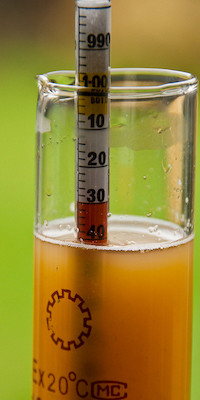
<p><img src="/assets/img/hydrometer-reading.jpg" alt="hydrometer in liquid in sample tube" class="centered" /></p>
<center>
  <small>
    Image credit: David Blaikie; original at https://www.flickr.com/photos/nikonvscanon/4379958640
  </small>
</center>

<p>And let us suppose that,
unlike in the picture above,
the bottom of the meniscus is exactly even with
the line that designates
a Specific Gravity of 1.020. 
So how do you write out the SG? 
I don’t mean whether to use a pen or pencil,
but rather <em>what exactly do you write?</em></p>

<p>There are two obvious choices, 1.02 and 1.020. 
So which makes the most sense?</p>

<p>You might think 1.02 is better because it’s more concise. 
After all, it’s the same value as 1.020, right? </p>

<p>Well, mathematically, yes,
but . . .
not really. 
(Especially to a scientist, engineer, or anyone else who
uses precision <em>precisely</em>.) 
1.02 covers a lot of territory. 
Anything from 1.015 to 1.024 <em>rounds</em> to 1.02 —
but those extremes <em>taste</em> quite different. 
So, it’s not really enough. 
Furthermore,
since we <em>usually</em>
write SGs to three digits,
we have to stop and wonder,
did you accidentally omit a digit? 
And if so, not only what was it,
but <em>where</em> was it? 
1.02x, 1.0x2, and 1.x02 are (in most cases) <em>vastly</em> different. 
But, if you write it as 1.020, that nails it down much more
precisely <em>and clearly</em>.</p>

<p>So why not 1.0200? 
If you’ve got the equipment to measure it that precisely,
go for it! 
But very few of us do, especially home hobbyist brewers. 
Even writing it out to three full digits is a bit misleading,
as it’s easy to misread it and be off by one or two points.</p>

<p>So, in summary,
writing it out to
two significant digits is not enough,
and four is more than is justified for most of us,
which makes three the sweet spot.</p>]]></content><author><name></name></author><category term="minutiae" /><summary type="html"><![CDATA[Let us suppose that you have just taken a hydrometer reading.]]></summary></entry><entry><title type="html">Honey Prices</title><link href="https://www.sumofabatch.com/blog/honey-prices" rel="alternate" type="text/html" title="Honey Prices" /><published>2022-02-16T00:00:00+00:00</published><updated>2022-02-16T00:00:00+00:00</updated><id>https://www.sumofabatch.com/blog/honey-prices</id><content type="html" xml:base="https://www.sumofabatch.com/blog/honey-prices"><![CDATA[<p>Recently someone asked in
<a href="https://www.facebook.com/groups/2204648847/" rel="nofollow" target="_new">the Facebook Mead group</a>
what’s a good price for honey and where would we buy from? 
Here’s a slight adaptation and expansion of my answer:</p>

<p>Price depends on variety, volume, and location. </p>

<p>The best price I’ve seen on
varietal honey of presumably decent quality,
is probably local-ish to me (middle of east coast USA). 
That would be
<a href="https://shop.wegmans.com/product/19651/wegmans-honey-clover-family-pack" rel="nofollow" target="_new">the five-pound jugs of clover honey</a>
at
<a href="https://wegmans.com/" rel="nofollow" target="_new">Wegman’s grocery stores</a>. 
They used to be $9.99 each ($2/pound),
but are now $13.99 ($2.80/pound). 
Unfortunately, Wegman’ses are only located in seven states,
in the mid-Atlantic coast and northeast. 
Elsewhere, some other chain might have a similar deal. 
Many chains, such as
<a href="https://www.costco.com/" rel="nofollow" target="_new">Costco</a>,
also have
<a href="https://www.costco.com/kirkland-signature-wild-flower-honey%2c-5-lbs.product.100516925.html" rel="nofollow" target="_new">5-pound jugs of <em>wildflower</em> honey</a>
at similar prices;
the ones linked there also used to be $9.99 each,
but are now $16.99 ($3.40/pound). 
(Eventually I may do a blog post on
<em>kinds</em> of honey,
including what I mean by
“wildflower”, “varietal”, and so on,
and why we care.)</p>

<p>The best price I’ve seen on any varietal <em>other</em> than clover,
in a volume I personally can make decent use of
(i.e., gallon or less, not a multi-gallon bucket),
is probably even more local to me. 
That is the two-pound jars of
<a href="https://www.facebook.com/Gunters-Honey-1486385934985598/" rel="nofollow" target="_new">Gunter’s Honey</a>
Orange Blossom,
allegedly
<a href="https://www.wholefoodsmarket.com/product/gunter-apiaries-honey-orange-blossom-32-oz-b00gp342fu" rel="nofollow" target="_new">available at Whole Foods for $8.99</a>,
at least
<a href="https://www.google.com/maps/place/Whole+Foods+Market/@38.9022469,-77.2648844,17z/data=!3m1!4b1!4m5!3m4!1s0x89b64bb7c529ff7d:0xa9606737baa27ed5!8m2!3d38.9024039!4d-77.2626494" rel="nofollow" target="_new">the store in Vienna, Virginia</a>. 
I didn’t notice it in the actual store when browsing a couple years ago,
but their web site lists it. 
No idea if it’s available outside Northern Virginia,
especially at that price,
since Gunter’s is only about an hour from me. </p>

<p>The second best price on a non-clover varietal,
is only an additional half-cent per pound! 
With an amazing variety of varietals
including some pretty exotic stuff,
and free shipping to at least anywhere in the continental USA
and presumably also Hawai’i and maybe even Alaska,
that would be the ten-pound pouches from Wao Kele Honey,
on the Big Island of Hawai’i,
<em>if</em> you buy more than one pouch. 
(If you buy only one they’re $50 each, but two or more are $45 each. 
I bought four, which is enough to last me a couple years. 
I got orange, lemon, tangerine, and lehua blossom honeys,
all of which make great “trads”. 
Just beware of how fast lehua crystallizes.) 
It also means supporting a small family business,
not a huge chain like Wegmans, Costco, Amazon,
or even things Amazon owns, like Whole Foods. 
Unfortunately, they have no significant web presence,
other than
<a href="http://hilofarmersmarket.com/waokelehoney.html" rel="nofollow" target="_new">their listing under the Hilo Farmers Market</a>. 
Apparently they have their hands full with
all the business they get at the Market
and from hanging out (not even advertising much)
in places such as
<a href="https://www.facebook.com/groups/2204648847/" rel="nofollow" target="_new">the Facebook “Mead” group</a>.</p>

<p>If you can make decent use of multi-gallon buckets,
there are lots more options. 
I’ve heard very good things about
<a href="https://www.gardnerbees.buzz/" rel="nofollow" target="_new">Gardner’s Bees</a>
and
<a href="https://www.walkerhoneyfarm.com/" rel="nofollow" target="_new">Walker Honey Farm</a>,
but can’t speak from experience.</p>

<p>Regardless of volume, though,
beware of deals that seem too good to be true. 
They often <em>are</em> too good to be true;
you’ll get that price on that quantity, all right,
but the honey is often adulterated with corn syrup,
or even downright fake. 
Anything below about $3 a pound, from a source you’re not familiar with,
should be viewed with suspicion.</p>

<p>On the other end of the scale, though,
exotic varieties and small quantities
can easily go for well over $20 per pound.</p>]]></content><author><name></name></author><category term="honey" /><summary type="html"><![CDATA[Recently someone asked in the Facebook Mead group what’s a good price for honey and where would we buy from?  Here’s a slight adaptation and expansion of my answer:]]></summary></entry><entry><title type="html">What’s in Your Wallet, er, I mean, Airlock?</title><link href="https://www.sumofabatch.com/blog/what-is-in-the-airlock" rel="alternate" type="text/html" title="What’s in Your Wallet, er, I mean, Airlock?" /><published>2022-02-08T00:00:00+00:00</published><updated>2022-02-08T00:00:00+00:00</updated><id>https://www.sumofabatch.com/blog/whats-in-the-airlock</id><content type="html" xml:base="https://www.sumofabatch.com/blog/what-is-in-the-airlock"><![CDATA[<p>Another common beginner question is:
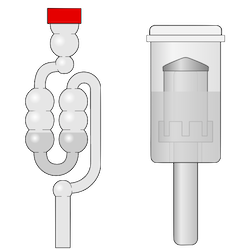
“That doesn’t look like water in your airlock, what is it?”</p>

<p class="center"><img src="/assets/img/s-and-3piece-airlocks.png" alt="s-type and three-piece airlocks, with fluid" /></p>
<p class="center tiny">picture credit: adapted from https://publicdomainvectors.org/en/free-clipart/image/18411.html</p>

<p>This is because most people start off putting water in their airlocks. 
That’s a perfectly reasonable choice —
but not the only one. 
Even with this approach, there’s the question of
what <em>kind</em> of water. 
So, the main choices of airlock liquid are:</p>

<ul>
  <li>
    <p><strong>The same water you made your must with</strong>. 
Probably easily available and cheap. 
But, it probably won’t do much to prevent
bacteria, mold, or even some kinds of insects from getting through. 
In fact, if you used spring water, well water, mineral water,
or any other water with much micronutrients in it,
it will probably <em>help</em> microbes grow.</p>
  </li>
  <li>
    <p><strong><em>Tap</em> water</strong>. 
You probably didn’t use this to make your mead,
as it is generally advised against. 
(Maybe I’ll cover that in a later post.) 
The chlorine in it
(in most cities of most advanced countries, anyway)
should help with the microbes . . .
but by the same token, if it gets into your must,
it could somewhat inhibit the yeast from working. 
(How would it get into your must, you ask? 
Long story short, if the ambient air pressure rises enough,
a three-piece airlock would pull some in. 
This is one advantage of an S-type airlock.)</p>
  </li>
  <li>
    <p><strong>Sanitizer fluid</strong>. 
While things such as Star-San are <em>supposed</em> to be
odorless, colorless, tasteless, and
perfectly harmless to humans,
I just <em>don’t like</em> the idea of it possibly winding up in my mead. 
Plus, it would inhibit the yeast more than tap water. 
Many of them work by being too acidic for microbes,
so it would further lower (acidify) the pH of your must.</p>
  </li>
  <li>
    <p><strong>Vodka</strong> (or other strong spirits). 
Now we’re talking! 
Anti-microbial, hostile to insects too,
and if it gets into your must,
it’s just water and alcohol, which are there already. 
Just be careful when using spirits with any distinctive flavor.</p>
  </li>
</ul>

<p>So what I suggest is
the cheapest vodka you can find,
from a reputable source
(not Uncle Bubba’s ‘shine still!),
in reasonable volume —
for whatever definition of “reasonable volume”
fits your needs and budget. 
If you’re just starting out,
and not sure you want to continue making mead,
maybe a half-pint hip-flask;
once you’re doing a new five-gallon batch every week,
it might be a gallon.</p>]]></content><author><name></name></author><category term="basics" /><category term="equipment" /><summary type="html"><![CDATA[Another common beginner question is: “That doesn’t look like water in your airlock, what is it?”]]></summary></entry><entry><title type="html">Starting Equipment</title><link href="https://www.sumofabatch.com/blog/starting-equipment" rel="alternate" type="text/html" title="Starting Equipment" /><published>2022-02-06T00:00:00+00:00</published><updated>2022-02-06T00:00:00+00:00</updated><id>https://www.sumofabatch.com/blog/starting-equipment</id><content type="html" xml:base="https://www.sumofabatch.com/blog/starting-equipment"><![CDATA[<p>So you want to start making mead,
but you’re worried about
how much you’ll have to spend on
equipment and supplies. 
Not to worry, it’s pretty cheap,
or at least cheaper than a typical setup for beer or wine.</p>

<p>The first thing you need is something to <em>hold</em> the batch. 
Actually you’ll probably need <em>two</em>,
so you can “rack” it from one to another. 
(I’ll probably explain that in another “basics” post later.) 
Your three main choices are:</p>

<ul>
  <li>
    <p>A quart or larger Mason-type jar. 
This is fine if you’re not really sure if you want to make mead,
or you’re on a very tight budget. 
You can <em>start</em> by just covering it with a piece of cloth,
held on with a rubber-band,
but if you get serious
(but still make such small batches)
you’ll want a lid with a
grommeted hole for an airlock (see below). 
Once you <em>know</em> you want to make more mead once in a while,
you’ll almost certainly want something larger.</p>
  </li>
  <li>
    <p>A one-gallon carboy, usually jug-style and made of glass. 
This is typical for low-volume hobbyists like me. 
If you’re on a tight budget
you could reuse a jug from apple juice or wine. 
If you really get into making mead,
these are also common in five-gallon and larger sizes. 
To close it, you’ll want a bung (rubber stopper) or cap,
with a hole for an airlock (see below).</p>
  </li>
  <li>
    <p>A brew-bucket, typically of about two gallon capacity. 
This is also common for low-volume hobbyists,
but available in much larger sizes if you get serious. 
Not just any bucket will do, mind you,
it must be of the right kind of plastic
to withstand the <em>alcohol</em> and <em>acidity</em> of mead. 
To close it, you’ll need a lid with a grommeted hole for your airlock.</p>
  </li>
  <li>
    <p>There are larger things, and fancier things,
but I don’t generally recommend them
until you are ready to really <em>commit</em>.</p>
  </li>
</ul>

<p>Regardless of what you use to hold your mead,
you’re going to need <em>multiple</em> things,
so you can transfer it from one to the other. 
(Why would you do that? 
I’ll probably cover that later. 
Meanwhile, if you’re curious, you can web-search
“rack off the lees”.) 
If you’re starting with small jars, okay, just get two jars,
else I’d recommend one plastic bucket and one glass jug-type carboy.</p>

<p>So how do you <em>do</em> that transfer? 
With quart jars and such
it’s not worth it
to do anything other than
“pour carefully”. 
With gallon-plus containers, though,
the best way is an
<a href="https://learn.kegerator.com/auto-siphon/" rel="nofollow" target="_new">autosiphon</a>,
but be sure to get one properly sized (in length and width)
for your containers. 
It’s very frustrating to find at the last minute
that you can’t autosiphon your mead out of your jug
because your autosiphon is too wide to fit! 
How long a siphon tube you want on that
depends on how you’re going to do the transfers. 
You may also want a
<a href="https://www.mrbeer.com/blog/post/how-to-use-a-bottling-wand-and-what-are-the-benefits-of-using-one" rel="nofollow" target="_new">bottling wand</a>
on the other end of the tubing;
that will also reduce the length of tube needed. 
You can find an auto-siphon, bottling wand, and tubing,
all sold together as a kit,
maybe even assembled.</p>

<p>I’ve already mentioned airlocks; you’ll need at least one. 
There are several kinds,
most notably “S” and “three-piece”. 
The S type is much easier to read, is generally cheaper,
and makes more of a fun “bloop” noise. 
;-) 
The three-piecer, however, is easier to clean
(by taking it apart),
is usually shorter
(important if you’re tight on space, vertically),
and can serve as an adaptor for a
<a href="https://beerandbrewing.com/when-to-use-a-blow-off-tube/" rel="nofollow" target="_new">blow-off tube</a>,
which is something I might cover in some later post.</p>

<p>One piece that many beginners regret doing without is a
<a href="https://www.grainger.com/know-how/equipment-information/kh-product-guide-how-to-use-a-hydrometer" rel="nofollow" target="_new">hydrometer</a>. 
This tells you the
<a href="https://en.wikipedia.org/wiki/Relative_density" rel="nofollow" target="_new">Specific Gravity</a>
of your mead
(or your must, your “mead to be”). 
I’ll spare you for now why you care about that. 
They’re usually glass so they’re a bit fragile,
so buy two, or a plastic one. 
You’ll also need a sample tube,
which is rather like the graduated cylinders
you used in chemistry or maybe physics class in school. 
(They may even <em>be</em> graduated,
but that’s not necessary for this purpose.) 
With a large enough batch of mead,
you <em>could</em> drop the hydrometer right in,
but it could break and ruin your batch,
or it could be difficult to extract from a jug-type carboy. 
And to get the sample <em>into</em> the tube,
you may find a turkey-baster useful —
yes, like you probably already have,
though I’d recommend a dedicated one.</p>

<p>Before <em>any</em> of this touches your mead/must, though,
it should be <em>sanitized</em>. 
So you’ll need some sanitizer concentrate,
such as Star-San,
and some decently large container
(like that two-gallon bucket I mentioned above!)
to mix it up in. 
You <em>could</em> use bleach instead,
but be sure to rinse <em>thoroughly</em> to get rid of the taste.</p>

<p>If you’re going to leave some sugar in it,
and make more at once than you can drink in a week or three,
you’ll also need a way to <em>stabilize</em> it. 
This <em>can</em> be done with heat,
but that’s rather tricky,
so the usual way is with <em>chemicals</em>,
such as the combination of
<a href="https://foodadditives.net/preservatives/potassium-metabisulfite/" rel="nofollow" target="_new">potassium metabisulfite</a>
and
<a href="https://www.grapeandgranary.com/winemaking/additives/stabilizer-sorbate.html" rel="nofollow" target="_new">potassium sorbate</a>
(aka K-meta and K-sorb)
or similar chemicals.</p>

<p>There are some other things that are optional but recommended,
especially if you’re going for gallons or larger:</p>
<ul>
  <li>yeast nutrients (no, raisins do <em>not</em> provide significant yeast nutrient)</li>
  <li>yeast <em>energizer</em> (very similar but used to <em>start</em> the yeast)</li>
  <li>pH buffering agents, and a pH meter or test strips</li>
  <li>“clearing” or “fining” agents, such as bentonite or SuperKleer</li>
</ul>

<p>Of course, there is an endless variety of
things you <em>could</em> go buy,
including books to detail it all.</p>]]></content><author><name></name></author><category term="basics" /><category term="equipment" /><summary type="html"><![CDATA[So you want to start making mead, but you’re worried about how much you’ll have to spend on equipment and supplies.  Not to worry, it’s pretty cheap, or at least cheaper than a typical setup for beer or wine.]]></summary></entry><entry><title type="html">Why Isn’t My Airlock Bubbling?</title><link href="https://www.sumofabatch.com/blog/why-isnt-my-airlock-bubbling" rel="alternate" type="text/html" title="Why Isn’t My Airlock Bubbling?" /><published>2022-02-02T00:00:00+00:00</published><updated>2022-02-02T00:00:00+00:00</updated><id>https://www.sumofabatch.com/blog/why-isnt-my-airlock-bubbling</id><content type="html" xml:base="https://www.sumofabatch.com/blog/why-isnt-my-airlock-bubbling"><![CDATA[<p>One frequently asked question is,
“I’ve definitely got fermenting going on;
I can see the bubbles rising inside the carboy. 
So why isn’t my airlock bubbling?”</p>

<p>Most likely, you’ve got an <em>air leak</em>. 
So long as you’ve still got fermentation happening,
this isn’t much of a problem. 
The CO2 being produced
should provide enough positive pressure
that you don’t have to worry about
oxygen or mold or bacteria
getting in. 
But, if you’re going to use the same equipment for
so-called “<em>secondary</em>”
(where there’s usually little to no fermentation going on),
make sure it’s sealed better then.</p>

<p>Even <em>with</em> active fermentation, though,
you might want your equipment sealed better,
so that <em>when that stops</em> you’re not running that risk. 
It will also enable the airlock to give you some clue
how active the fermentation is. 
(Caveat: airlock bubbles do not always mean fermentation,
and lack does not mean lack. 
Bubbles could be from off-gassing,
and <em>apparent</em> lack could be from it just
bubbling too slowly for you to notice.)</p>

<p>So how do you seal your container better? 
It depends what kind of container you’ve got.</p>

<p>Buckets are great for primary,
for reasons I <em>might</em> cover later. 
But most of them don’t seal very well. 
For snap-on lids,
this can often be solved with
a gasket inside the lid, where the rim of the bucket fits in. 
If you can’t find suitable ready-made gaskets,
you can make one by twisting up some plastic-wrap. 
You could also try putting duct tape
around the lid,
securing it better to the bucket. 
(Yes, this makes it more of a PITA to get the lid off and back on.) 
For screw-on (such as Gamma) lids,
I don’t know, but taking a wild guess,
maybe some teflon tape on the screw threads might help,
just like with plumbing. 
If it’s a <em>very</em> loose fit,
maybe something thicker,
like masking tape.</p>

<p>But what about jug-type carboys,
like most of us use for one-gallon batches? 
If your carboy has a handle or two,
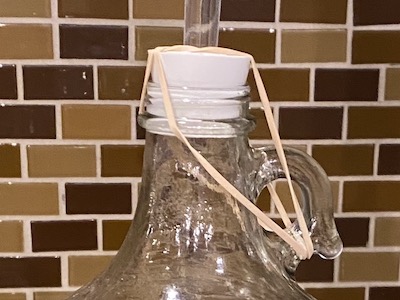
you can use a rubber band
to apply a bit of downward pressure on the bung,
as in this picture:</p>

<p class="center"><img src="/assets/img/bung-secured-w-rubber-band.jpg" alt="bung secured in carboy with rubber band" /></p>

<p>(The rubber band forms an X
between the airlock stem
and the edge of the bung
opposite the handle. 
If your carboy has <em>two</em> handles,
you’ll find it much easier to arrange it
in a way that will balance the forces
so it doesn’t tilt the airlock.)</p>

<p>This should give you enough
downward pressure on the bung
to keep it airtight in the neck —
but not <em>so</em> securely that
it would increase the risk of bottle bombs
(in the event that your must clogs the airlock for whatever reason).</p>

<p>But what if your jug doesn’t <em>have</em> handles,
as is fairly common on European “demijohns”,
multi-gallon carboys,
and large-lidded carboys with bung-holes in them,
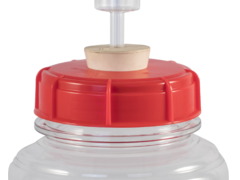
such as this Fermonster lid?</p>

<p class="center"><img src="/assets/img/fermonster-lid.png" alt="fermonster lid with bung and airlock" /></p>

<p>If there’s any kind of <em>rim</em>,
such as below this Fermonster’s lid,
you can tie a piece of string below <em>that</em>,
and attach your rubber band(s) there. 
(Depending how much of a rim there is,
you may need to tie it very tightly,
but leave extra string to form a loop,
and attach them to <em>that</em>.)</p>

<p>If you’re using a <em>large</em> or <em>heavy</em> carboy/demijohn,
you might have it in
a <em>harness</em>
or a <em>basket</em>. 
If so, you can attach your rubber bands to <em>that</em>. 
(Again, possibly with the aid of string.)</p>

<p>If you are using something with a <em>grommeted</em> lid,
perhaps the lid and/or the grommet itself is leaking.</p>

<ul>
  <li>
    <p>The lid might not be sealing well
against the mouth of the jar. 
Try a gasket,
either just inside the underside,
or in the form of a liner. 
(A liner can also help with a leaky grommet with too big a gap.)</p>
  </li>
  <li>
    <p>The outer diameter of the grommet’s body may be
too much smaller than the hole in the lid. 
The easiest fix for this to get a larger grommet. 
(But then you’ll probably have one of the below problems.) 
Or, you can get/make another lid,
with a smaller hole. 
If your fine motor skills are excellent,
you can <em>try</em> wrapping a thin strip of tape
around the grommet’s body.</p>
  </li>
  <li>
    <p>The grommet’s gap, between the upper and lower flaps,
may be too much larger than
the thickness of the lid. 
You can fix this with some kind of shim,
just to take up space. 
It would be easier, safer, and probably more effective,
to stick this under the upper flap,
<em>outside</em> your fermenter,
rather than above the lower one,
<em>inside</em>. 
But, if the whole <em>lid</em> doesn’t seal well either,
you might want to line that whole thing.</p>
  </li>
  <li>
    <p>The grommet’s hole may be too big for your airlock’s stem. 
In this case, wrapping some tape
(cellophane, teflon, masking, whatever)
around the airlock stem can make it big enough to fit snugly.</p>
  </li>
</ul>

<p>There are probably a few more not leaping to my poor little brain. 
Eventually I will install a comment system here and you can ask.</p>

<p>EDITED TO ADD:</p>

<p>So how do I tell if my bucket is leaking? 
Push down very gently on the top,
and see if that gives you much airlock activity. 
Before letting go, keep your pressure on it,
and see if the airlock rebalances itself. 
If you don’t get <em>any</em> activity when you push,
it’s leaking like a sieve! 
If you only get a little, it <em>may</em> still be leaky;
use your own judgement in comparing the airlock activity
to how much you would expect,
given how much you flexed the lid;
you could try pushing more. 
If it rebalances itself with the pressure still on,
you’ve definitely got a leak. 
If it doesn’t, you probably don’t, at least not a serious one.</p>]]></content><author><name></name></author><category term="tips-n-tricks" /><summary type="html"><![CDATA[One frequently asked question is, “I’ve definitely got fermenting going on; I can see the bubbles rising inside the carboy.  So why isn’t my airlock bubbling?”]]></summary></entry><entry><title type="html">What Makes It Mead?</title><link href="https://www.sumofabatch.com/blog/what-makes-it-mead" rel="alternate" type="text/html" title="What Makes It Mead?" /><published>2022-01-28T00:00:00+00:00</published><updated>2022-01-28T00:00:00+00:00</updated><id>https://www.sumofabatch.com/blog/what-makes-it-mead</id><content type="html" xml:base="https://www.sumofabatch.com/blog/what-makes-it-mead"><![CDATA[<p>Someone recently asked on
<a href="https://www.facebook.com/groups/2204648847" rel="nofollow" target="_new">the Facebook Mead group</a>,
if anybody had ever used
half honey and half high sugar apple juice
to make mead.</p>

<p>The main answer was that
such a mix would yield too high a starting gravity
to ferment well. 
That seemed to me to be
<a href="https://www.explainxkcd.com/wiki/index.php/1339:_When_You_Assume" rel="nofollow" target="_new">ass-u-me</a>-ing
that the halves were by volume
(though I think halves by weight would yield similar results).</p>

<p>But it got me thinking…
what if it were halves by “sugar contribution”,
so that half the fermentable sugars
were from the honey
and the other half
were from the apple juice?</p>

<p>One problem in the mead world is that
there is no universal definition of mead,
except that it contains
at least some significant amount of
alcohol derived from fermenting honey. 
Some <em>legal jurisdictions</em> have their own definitions,
usually for <em>tax</em> purposes,
but of course they differ,
and are generally made by
bureaucrats with no clue what they’re talking about. 
This often results in the definitions seeming a bit arbitrary —
51% is fairly common,
so something at, say, 50.9% is not mead,
which I find ridiculous. 
(Did their math education never extend beyond “whole numbers”?) 
Mead <em>competitions</em> also have their own definitions,
not only for “what is mead”
but usually many <em>categories</em> as well,
though that’s beyond the scope of this blog post.</p>

<p>Exact halves by sugar-contribution would be
on the borderline of most people’s definitions of “mead”,
so some folks would deny that it’s truly mead. 
I generally go by the definition
that <em>most</em> of the fermented sugars
(half plus one molecule)
have to be from honey,
in order to <em>definitely</em> call it mead. 
So, if I were making this mix,
I might hesitate to call it mead. 
However, many others say “at least half”. 
So if <em>you</em> want to call it mead,
go right ahead,
but you could also call it wine,
and that gets into a gray area of “what is this thing, really?”. 
I don’t care about it enough to argue,
other than for the sake of meta-arguing about the definition. 
;-)</p>

<p>Just for the sake of completeness:
I’ve also heard some people say it’s mead if
the honey-derived alcohol is a <em>plurality</em>
(more than from any other ingredient),
or <em>at least</em> as much as any other ingredient. 
I could agree with that <em>if</em>
“other ingredient” is broadened to
“other <em>category</em> of ingredient”. 
So, frex, if the sugars are
30% from grapes,
30% from pears,
and 40% from honey,
I’d say it’s a
<em>multi-fruit wine</em> with honey <em>also</em> fermented in it. 
But if those are the proportions and it’s from
grapes, <em>some kind of grain</em>, and honey,
okay, I won’t object to calling it mead. 
And if it’s exactly 1/3 of each,
we’re back to
“it’s on the borderline,
call it wine, beer, mead, whatever,
I don’t care enough to argue.”</p>]]></content><author><name></name></author><category term="minutiae" /><summary type="html"><![CDATA[Someone recently asked on the Facebook Mead group, if anybody had ever used half honey and half high sugar apple juice to make mead.]]></summary></entry><entry><title type="html">Using Bread Yeast</title><link href="https://www.sumofabatch.com/blog/using-bread-yeast" rel="alternate" type="text/html" title="Using Bread Yeast" /><published>2022-01-27T00:00:00+00:00</published><updated>2022-01-27T00:00:00+00:00</updated><id>https://www.sumofabatch.com/blog/added-honey-to-marys-mead</id><content type="html" xml:base="https://www.sumofabatch.com/blog/using-bread-yeast"><![CDATA[<p>Recently someone on a forum asked about using bread yeast. 
Since that’s such a common question,
I decided to record my answer here.</p>

<p><code class="language-plaintext highlighter-rouge">===8&lt;---cut-here-for-answer---</code></p>

<p>Generally speaking, you want the yeasts
intended for wine, beer, or cider,
or the occasional rare variety intended for mead,
not for bread. 
These have been bred (no pun intended)
to have a particular level of alcohol tolerance
(though that is only a rough guide),
temperature tolerance,
production of esters,
and other characteristics often important in brewing. 
Bread yeast has mainly been bred to have a given level of CO2 production,
as that’s what makes bread rise. 
To us, that’s just a byproduct,
usually to be gotten rid of
(unless we’re trying to make it sparkling).</p>

<p>That said, it’s certainly possible to make a decent mead with bread yeast, and there are recipes that call for it – but you’ll get a much more consistent, and usually better, mead with yeasts intended for brewing.</p>]]></content><author><name></name></author><category term="yeasts" /><summary type="html"><![CDATA[Recently someone on a forum asked about using bread yeast.  Since that’s such a common question, I decided to record my answer here.]]></summary></entry><entry><title type="html">How I Met Your Mother, er, I mean, Mead</title><link href="https://www.sumofabatch.com/blog/how-i-met-mead" rel="alternate" type="text/html" title="How I Met Your Mother, er, I mean, Mead" /><published>2022-01-17T00:00:00+00:00</published><updated>2022-01-17T00:00:00+00:00</updated><id>https://www.sumofabatch.com/blog/how-i-met-mead</id><content type="html" xml:base="https://www.sumofabatch.com/blog/how-i-met-mead"><![CDATA[<p>I think I first heard of mead when reading
<a href="https://en.wikipedia.org/wiki/Beowulf" rel="nofollow" target="_new">Beowulf</a>
in Brit-Lit (British Literature) class in high school in about 1979. 
(Yes, it’s technically British, though it’s about Danes. 
Remember, it was written in 
<a href="https://en.wikipedia.org/wiki/Old_English" rel="nofollow" target="_new">Old English</a>.) 
To the best of my recollection, though,
I never actually <em>had</em> mead until sometime around fifteen years later,
when my best friend’s girlfriend
(no, she didn’t 
<a href="https://www.youtube.com/watch?v=XkSmLh2Hbi0" rel="nofollow" target="_new">used to be mine</a>)
brought some to
<a href="http://www.pennsicwar.org/" rel="nofollow" target="_new">Pennsic</a>,
the big annual East-coast USA shindig of the SCA
(<a href="https://www.sca.org/" rel="nofollow" target="_new">Society for Creative Anachronism</a>).</p>

<p>In the early 2010’s, my wife bought me some mead kits,
which I made and enjoyed. 
So that was my first time <em>making</em> mead,
though I was still pretty clueless about
<em>why</em> I was doing each step,
what could be done <em>differently</em>,
and <em>why</em> one might.</p>

<p>A few years later, we were in
<a href="https://www.google.com/maps/place/Colchester,+VT" rel="nofollow" target="_new">Colchester, Vermont</a>,
looking for dinner near our hotel,
and
<a href="https://yelp.com/" rel="nofollow" target="_new">Yelp</a>
suggested
<a href="http://www.colchestersmeadhall.com/menu.html" rel="nofollow" target="_new">Colchester Mead Hall</a>. 
There wasn’t much else close by,
they had some food that sounded good,
I was curious about mead,
and . . . they did flights! 
So that was my first taste of <em>commercial</em> meads. 
(Since then I’ve had flights at various other meaderies,
such as
<a href="https://www.silverhandmeadery.com/" rel="nofollow" target="_new">Silver Hand</a>
fairly close to home in
<a href="https://www.google.com/maps/place/Williamsburg,+VA" rel="nofollow" target="_new">Williamsburg, Virginia</a>,
and
<a href="https://nanimoonmead.com/" rel="nofollow" target="_new">Nani Moon</a>
much further away,
<a href="https://www.google.com/maps/place/Kapa%CA%BBa,+HI" rel="nofollow" target="_new">Kapa’a, Hawai’i</a>,
on
<a href="https://www.google.com/maps/place/Kauai" rel="nofollow" target="_new">Kauai</a>.)</p>

<p>Fast forward to 2020. 
The COVID pandemic had started to take hold. 
There was lockdown. 
Stores were running very low on the usuals:
milk, toilet paper, and <em>bread</em>. 
People were starting to bake their <em>own</em> bread. 
Pretty soon, stores were starting to run low on <em>baking yeast</em>. 
My wife has a friend who bakes a lot . . .
and who offered to share out her stash of yeast.</p>

<p>That got me wondering . . . <em>can</em> you make beer, wine, etc.,
with <em>bread</em> yeast? 
I researched, and found a recipe for
Joe’s Ancient Orange Mead, aka JAOM. 
(Not linked here because it’s a careful balance of <em>bad habits</em>
that you shouldn’t get started on. 
Lots of people also try to modify it,
that doesn’t work out well,
and they get discouraged and quit mead.) 
For the second kit,
I had gone to my LHBS
(which <em>really is</em> called
<a href="https://mylhbs.com/" rel="nofollow" target="_new">My Local HomeBrew Shop</a>)
and gotten “real equipment”,
i.e., an actual carboy, plus caps with and without holes, and an airlock,
so I was well equipped to just go ahead and make it,
so I did!</p>

<p>It turned out pretty good . . . but much sweeter than I liked. 
By that time I had started hanging around in
<a href="https://www.facebook.com/groups/2204648847/" rel="nofollow" target="_new">the Facebook “Mead” group</a>,
where BTW I am now dubbed a “Group Expert”. 
(Guess that doesn’t take much beyond running off at the keyboard!) 
I gained a basic understanding of the process,
and realized that I could use the half-packet of
<a href="https://mangrovejacks.com/products/mead-m05-yeast-10g" rel="nofollow" target="_new">Mangrove Jack M05</a>,
that I had left over from the second kit,
to chew through some of those sugars…
while still leaving <em>some</em> behind. 
That brought it down from a much-too-sweet 1.04something
to a much nicer 1.02something. 
And of course the extra alcohol was a nice bonus!</p>

<p>Now I was thoroughly hooked on mead. 
I found a number of other resources
(see <a href="/links">Links</a>),
and my eyes were opened to the even wider world of mead. 
I’ve since made several more batches
(including some JAOM variants, <em>some</em> of which turned out okay),
planned many more,
and learned enough that I feel compelled to share it with the world. 
It’s also something to keep me out of
<em>too</em> much trouble
now that I’m semi-retired . . .
and just <em>might</em> provide barely enough income for
<a href="https://www.codosaur.us/" target="_new">Codosaurus</a>
to turn a profit,
to keep
<a href="https://www.irs.gov/" rel="nofollow" target="_new">the IRS</a>
happy with the shiny-tech-toy deductions I want to keep taking. 
:-)</p>]]></content><author><name></name></author><category term="daves-mead-adventures" /><summary type="html"><![CDATA[I think I first heard of mead when reading Beowulf in Brit-Lit (British Literature) class in high school in about 1979.  (Yes, it’s technically British, though it’s about Danes.  Remember, it was written in Old English.)  To the best of my recollection, though, I never actually had mead until sometime around fifteen years later, when my best friend’s girlfriend (no, she didn’t used to be mine) brought some to Pennsic, the big annual East-coast USA shindig of the SCA (Society for Creative Anachronism).]]></summary></entry><entry><title type="html">Backsweetened Mary’s-Honey and Blackberry Mead</title><link href="https://www.sumofabatch.com/blog/added-honey-to-marys-mead" rel="alternate" type="text/html" title="Backsweetened Mary’s-Honey and Blackberry Mead" /><published>2022-01-16T00:00:00+00:00</published><updated>2022-01-16T00:00:00+00:00</updated><id>https://www.sumofabatch.com/blog/added-honey-to-marys-mead</id><content type="html" xml:base="https://www.sumofabatch.com/blog/added-honey-to-marys-mead"><![CDATA[<p>Today’s Mead Adventure was
about the batch I’m making
for a party of local high school alumni. 
It’s made with honey from
my high school friend Mary Melchior,
who has a hive atop the Georgetown Quaker meetinghouse,
plus some blackberries from beside my house
(and many more from the store,
because this season’s yield was poor).</p>

<p>Last time, the gravity had gotten down to 0.997,
and was pretty much stable. 
So, I had racked it into secondary
(in a <a href="https://www.northernbrewer.com/products/fermonster-3-gallon-fermenter" rel="nofollow" target="_new">three-gallon Fermonster</a>),
stabilized it (with potassium metbisulfite and potassium sorbate),
and added another couple pounds of blackberries,
for it to “sit on” for a couple weeks or so,
after which I planned to backsweeten.</p>

<p>That was a couple weeks <em>ago</em>. 
So today, I first tried racking it into
my brand-new
<a href="https://www.homebrewohio.com/home-brew-ohio-complete-2-gallon-fermenting-bucket/" rel="nofollow" target="_new">Homebrew Ohio two-gallon bucket</a>. 
Unfortunately, I had forgotten to make sure that
the tip of the bottling wand was pressed against something,
so the autosiphon wasn’t drawing properly,
and spewed some of the mead out the bottom,
disturbing the lees,
so I couldn’t exclude them very well,
so I wound up transferring the whole darn thing, lees and all.</p>

<p>To actually do the backsweetening,
I took four ounces
(by volume, therefore almost six by weight)
from the <em>other</em> 28-oz jar of honey she had given me. 
(By my calculations, that should bring the gravity up to about 1.011,
at the low end of the semi-sweet range.) 
It had crystallized a good bit,
so I couldn’t just pour it into my half-cup measure,
but spooned it in,
scraping it off the tablespoon
with the edge of the measuring cup. 
Then I extracted a cup of the mead,
put it in a large glass,
microwaved it for about thirty seconds,
spooned the honey into that,
and stirred it in as best I could. 
Even that wasn’t very successful,
so I wound up stirring several samples of the mead in the glass
to try to get more honey off it,
and reaching into the mead
with my (sanitized) rubber gloves on
to <em>rub</em> the honey off of the spoon and measuring cup.</p>

<p>While I had the batch open, I also opened the bag of berries,
removed all but one of the glass food-fermenting weights,
squeezed out all the juice/mead that I could,
and tied it shut again. 
Since it was now much lower volume,
and the bucket is skinnier than the Fermonster,
it is now fully submerged,
so I don’t have to worry about swirling it or punching it down. 
That’s a relief, since the bucket is opaque and difficult to open.</p>

<p>The squeezing was rather difficult,
despite my having punched many skewer-holes in it two weeks ago. 
So, I think I will not be using cold-brew coffee bags again,
but switch to the usual recommendation of muslin or cheesecloth. 
There are probably good reasons those <em>are</em> the usual recommendation,
and not just because the usuals haven’t been updated since the invention of
cold-brew coffee bags.</p>

<p>After all that, I transferred the bag of berries, and sealed the bucket. 
Contrary to the general reputation of brewing buckets,
and many of the Amazon reviews of the one I bought,
it sealed excellently. 
I could tell because there was steadily growing pressure
visible in the airlock.</p>

<p>(That was a bit of a relief,
as it means that the mead will have
a protective blanket of CO2 over it,
rather than being subject to more oxidation. 
I’m sure there was plenty oxidation going on in the Fermonster. 
:-( 
No slam on that fine product, just that I had left hella headspace,
and didn’t see any airlock activity while the mead was in it.)</p>

<p>Now the question is, <em>why</em> the pressure? 
It shouldn’t be fermenting much if any,
because the mead had been <em>stabilized</em>. 
Maybe the effectiveness of the chemicals fades with time,
so that introduction of new yeast could continue fermentation? 
I’ll try to make sure the honey is all dissolved
and take a gravity reading Real Soon Now,
then see what the gravity does over the course of a week or so. 
Or maybe it was just off-gassing? 
It probably wasn’t just a change of temperature,
as the air in the bucket was the same temperature
where I had filled it versus where I had placed it.</p>

<p>(Eventually I’ll install a commenting system here. 
Meanwhile, you can chime in on
<a href="https://www.facebook.com/groups/2204648847/" rel="nofollow" target="_new">the Facebook Mead group</a>.)</p>]]></content><author><name></name></author><category term="daves-mead-adventures" /><summary type="html"><![CDATA[Today’s Mead Adventure was about the batch I’m making for a party of local high school alumni.  It’s made with honey from my high school friend Mary Melchior, who has a hive atop the Georgetown Quaker meetinghouse, plus some blackberries from beside my house (and many more from the store, because this season’s yield was poor).]]></summary></entry></feed>